A construction schedule template serves as a structured, visual roadmap for building projects, outlining tasks, deadlines, and resources. Ultimately, it supports on-time, budget-conscious delivery by acting as a planning, tracking, and communication tool to coordinate trades and prevent delays.
Such a template also helps teams coordinate the multiple moving parts of a building project, from site preparation to final inspection. It also provides structure for sequencing tasks, managing subcontractors, and tracking deadlines. Thus, it will help your project work progress smoothly across every phase of construction.
While these are the roles that are played by such a template, what are the thorough benefits of using it for project management? Here, let’s look into the 10 project management tasks that are made better by the application of a construction schedule template.
1. Better Task Sequencing and Logical Workflows
If you look at the work breakdown structure of any construction project, it has a strict and logical order. In many cases, Task B cannot start until Task A has completed. For example, you can only pour concrete after the site is excavated.
A construction work schedule template will help visualize this dependency between tasks and prevent situations where the appropriate order gets jumbled up. For example, the construction crew shows up before the material delivery is completed.
Here is a sample construction schedule to better explain this breakdown:
| Tasks | Status | Start Date | End Date | Duration |
| Planning | Complete | 9/21/2025 | 9/30/2025 | 10 |
| Raw Material Accumulation | Complete | 10/1/2025 | 10/6/2025 | 6 |
| Basement Creation | Complete | 10/6/2025 | 10/24/2025 | 19 |
| Floors Creation | Complete | 10/25/2025 | 10/29/2025 | 5 |
| Light Fittings | Complete | 11/1/2025 | 11/13/2025 | 13 |
| Sewage Pipelines | Complete | 11/13/2025 | 11/15/2025 | 3 |
| Paintings | In Progress | 10/25/2025 | 12/5/2025 | 20 |
| Accessories Installation | In Progress | 11/19/2025 | 12/10/2025 | 22 |
| AC Installation | In Progress | 10/29/2025 | 12/9/2025 | 5 |
| Fire Extinguishers | In Progress | 11/22/2025 | 12/15/2025 | 24 |
| Parking Space | On Hold | 11/29/2025 | 12/20/2025 | 22 |
| Appliances | On Hold | 12/10/2025 | 12/22/2025 | 13 |
| Plumbing | In Progress | 12/10/2025 | 12/15/2025 | 6 |
| Final Inspections | Not Started | 12/27/2025 | 12/30/2025 | 4 |
| Wrap-up | Not Started | 12/3/2025 | 12/21/2025 | 19 |
| House Cleaning | Not Started | 1/3/2026 | 1/23/2026 | 21 |
| Completion | Not Started | 1/3/2026 | 1/17/2026 | 15 |
Table 1: Sample Construction Schedule
Thus, a template will help define the dependencies early on and help project managers ensure that the workflow is efficient and logical.
2. Improved Allocation and Management of Resources
A well-structured construction schedule allows for a more optimal allocation of resources, which includes labor, materials, and equipment. By mapping tasks against the resource availability, managers can prevent issues such as overbooking crew members or planning for excess equipment that stays idle.
Thus, with the help of a construction project schedule template, a proactive management approach is considered that reduces downtime and minimizes the costs brought on by underutilization of resources.
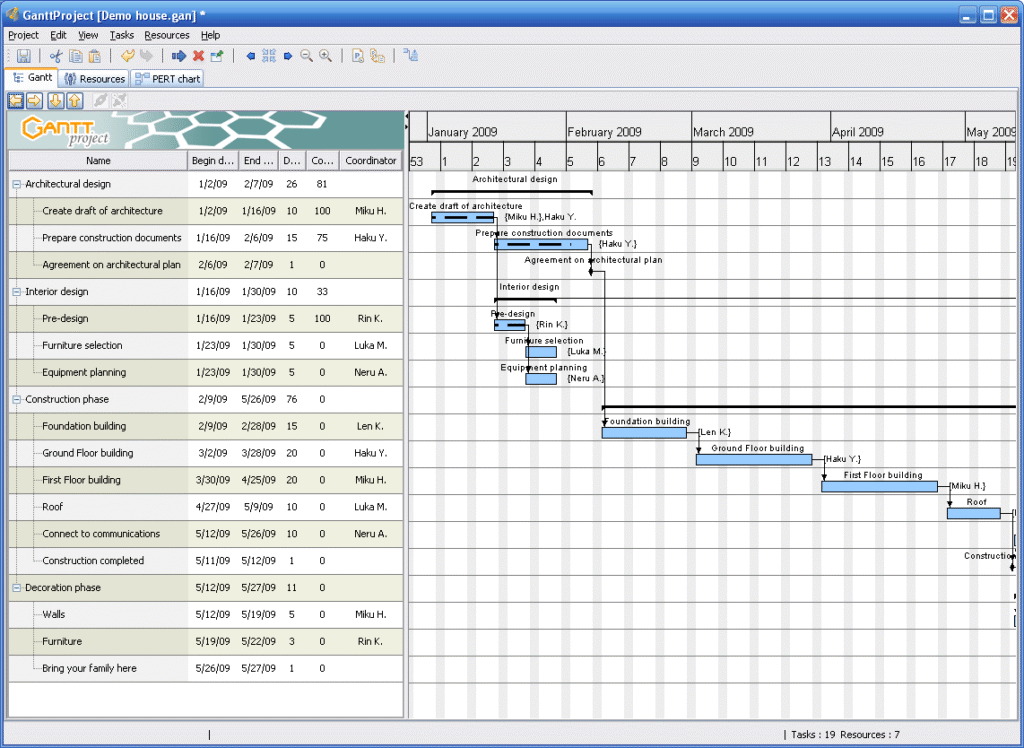
Here is a construction schedule example with a Gantt chart representation to explain how visualization with a Gantt chart helps the schedule:
3. Clear Visualization Using a Gantt Chart
Many construction work plan templates consider a Gantt chart format, which displays tasks, durations, and dependencies on horizontal bars on a timeline. This visual representation can make complex projects easy to understand.
Thus, it allows team members to see where the tasks overlap, understand the current progress level, and immediately evaluate how a delay in one task can affect the rest of the project.
Here is a construction schedule example with a Gantt chart representation to explain how visualization with a Gantt chart helps the schedule:
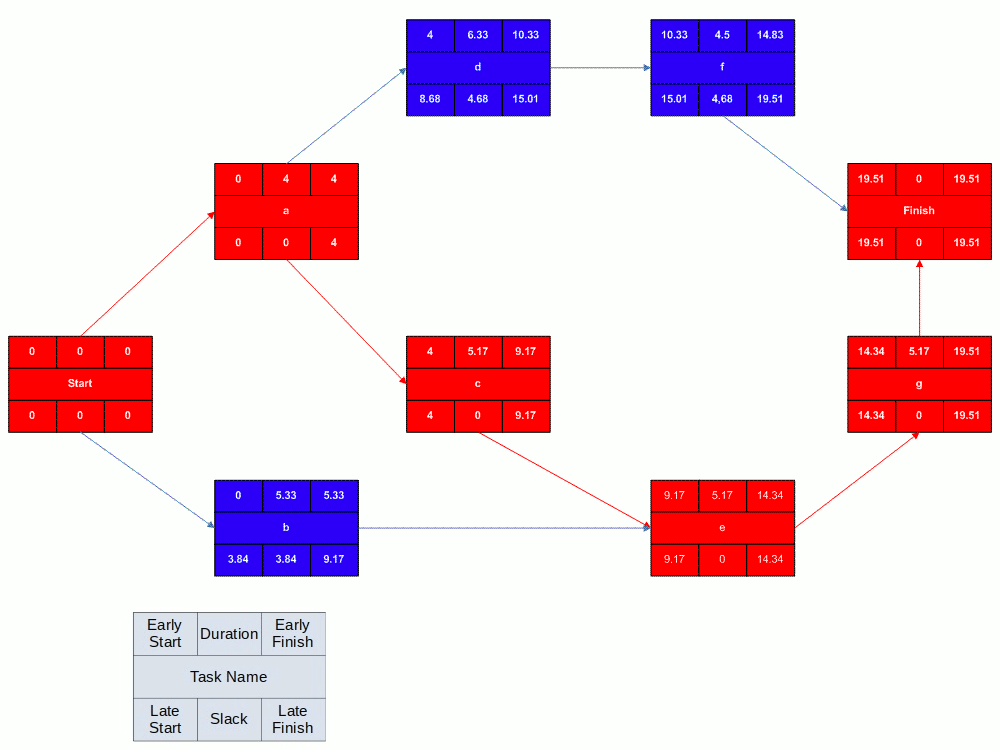
4. Early and Clear Identification of the Critical Path
The construction work schedule template represents all the construction project tasks in order, evaluating how each of the tasks is dependent on another and how long each task will take. Therefore, you have the right order for the tasks and a clear timeline.
With the help of this clear timeline, you will be able to discover the best sequence of tasks dictating the minimum project duration. Thus, with the help of the template, project managers can prioritize these critical items and can avoid costly delays.
Here is a sample critical path diagram to help understand the concept:
5. Increased Efficiency in Risk Management and Contingencies
A construction project is often susceptible to unforeseen events, such as adverse weather, material shortages, or even changes in design. A comprehensive schedule template allows for the incorporation of buffer items or can float into the schedule.
Therefore, a construction work schedule template can help identify the potential risks early. And it can also aid project managers in creating contingency plans to help protect the project from the impact of unexpected and costly setbacks.
6. Introduction of Standardization in Project Planning
A construction schedule template can inject standardization into the planning processes of a project. This is because, when a template is applied, it brings consistency to how projects are planned across all the moving parts in an organization.
A standardized template will also ensure that the essential elements, such as permits, procurements, inspections, and closeout, are not ignored. It is this uniformity that makes it easier for project managers to simplify the understanding of even the most convoluted project workflows.
7. Better Time Control and Reduction in Delays
A commercial construction schedule template enables project managers to set realistic timelines and deadlines for each project activity.
Moreover, with regular updates to the schedule, managers are better able to track the actual progress against the planned timeline. And that makes it easy to identify potential deviations quickly and take the appropriate corrective actions before they can affect the final deadline.
8. Improvements in Communication Among Stakeholders
A residential construction schedule template acts as a central reference point for all the participants engaged in a residential project. This is also true for all forms of construction projects, where owners, contractors, and subcontractors can all use the construction schedule as a clear insight into the project.
Furthermore, a template can keep everyone aligned, reducing misunderstandings and miscommunications and minimizing any potential for legal disputes.
9. Enhancements in Budget Management and More Financial Control
A schedule is closely tied to the overall budget. Also, by tracking the progress, managers can align payment applications with the completed work. Thus, a construction schedule template ensures that payments are only released when all the milestones are met.
A well-maintained schedule can also help prevent costly changes to the work, which can be a major driver for budget overruns.
10. Improvements in Client and Stakeholder Satisfaction
The delivery of a project on time and within the budget is the base goal for any construction project manager. A detailed and regularly updated schedule provides clarity and transparency on project progress.
Thus, well-managed project progress can significantly improve stakeholder satisfaction. It also provides owners with confidence in the project’s management and strengthens long-term relationships.
Final Thoughts
Construction schedule templates are beyond just spreadsheets. They are essential project management tools that can bring structure, clarity, and control to the complex and fast-paced world of construction. By applying a template, project managers can minimize risks of delays and additional costs, while also being able to improve communication and deliver successful projects on time.
Need Consultancy on Baseline Schedules? Select Today!
For a successful construction project, baseline schedules such as construction schedules can be ideal. So, contacting the right service provider can be the right call. Choose our expert services and ensure project success today!
Frequently Asked Questions (FAQs)
1. Can using construction schedule templates save time for project managers?
Pre-designed schedule templates eliminate the need to create a project plan from scratch, and be able to immediately input specific tasks, durations, and dependencies. These reduce initial setup time and will allow for rapid and consistent planning across projects.
2. Can a construction schedule template facilitate improved project monitoring?
A template can be the baseline against which a project’s progress is measured. Thus, it provides a clear target and helps understand delays and manage errors. Therefore, a template can aid in managing the project progress.
3. How do these templates enhance team accountability?
Templates allow tasks to be assigned to specific individuals and teams. They also provide clear start and finish dates. This transparency also makes it easier to hold team members accountable for project deliverables and boost productivity.
4. Will an existing template prove helpful for future projects?
Templates also act as a repository of historical data, with task durations and evaluation of progress with lessons learned. It can be used as a base template for a future project, based on which planning accuracy is improved, leading to efficient project delivery in the future.